
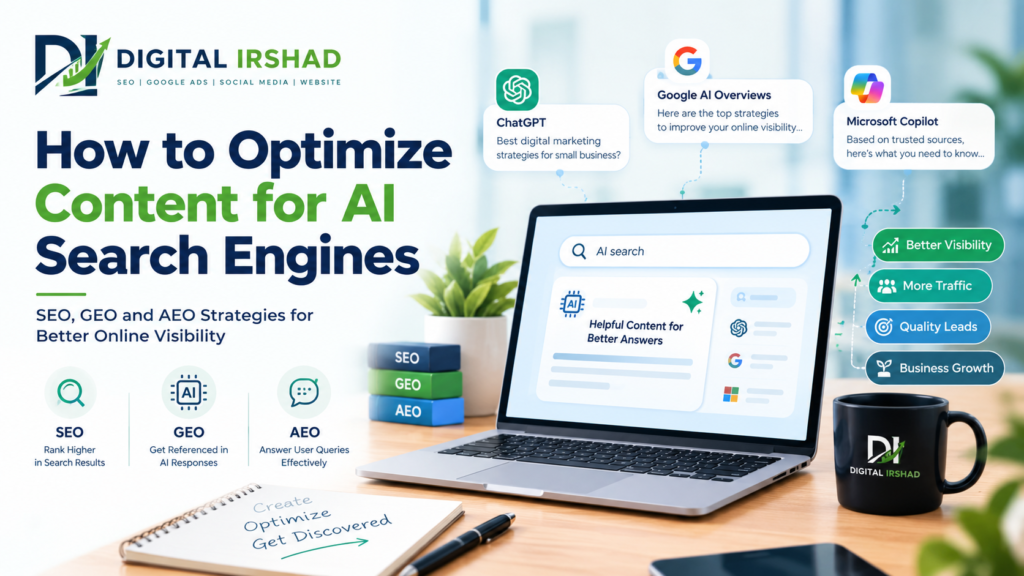
How to Optimize Content for AI Search Engines: SEO, GEO and AEO Strategies for Better Online Visibility

AI Search is changing. People no longer rely only on traditional Google results to find information, compare services, and make purchasing decisions. They also use AI-powered tools such as ChatGPT, Google AI Overviews, Google AI Mode, and Microsoft Copilot to ask questions and discover relevant websites.
For businesses, this creates a new opportunity: make website content easy for search engines and AI-powered systems to discover, understand, trust, and reference.
Optimizing content for AI search engines involves more than adding keywords. It requires useful information, strong technical SEO, clear answers, credible sources, and content that genuinely helps the reader.
At Digital Irshad, the focus is on practical SEO strategies that help businesses improve online visibility, attract relevant website visitors, and generate meaningful enquiries. This guide explains how SEO, Generative Engine Optimization (GEO), and Answer Engine Optimization (AEO) work together to support modern search visibility.
AI Search Engine Optimization: What Does It Mean for Your Website?
AI search engine optimization is the process of improving a website so its content can be discovered and understood across traditional search engines and AI-powered search experiences.
Traditional SEO focuses on improving a website’s eligibility and visibility in organic search results. GEO focuses on content being considered and referenced in generative AI responses. AEO focuses on answering specific questions clearly and directly.
Although these terms describe different emphases, they share the same foundation: create helpful content, maintain a technically accessible website, demonstrate credibility, and satisfy the user’s search intent.
For example, someone searching for a digital marketing freelancer in Mumbai may use Google Search, ask ChatGPT for recommendations, or use an AI-powered search experience to compare marketing services.
A useful website should clearly explain its services, experience, location, process, and contact information so potential customers can evaluate whether the business meets their needs.
GEO Content Optimization: How Generative Engine Optimization Works
Generative Engine Optimization, commonly called GEO, refers to strategies intended to improve the likelihood that content is discovered, understood, or referenced in AI-generated answers.
AI-powered systems may use different search, retrieval, and ranking processes. Their responses can change depending on the question, available sources, location, and the system being used.
Businesses can strengthen their content foundation by:
- Publishing original, informative content that answers genuine customer questions.
- Explaining important concepts with clear definitions and practical examples.
- Supporting factual claims with reliable sources.
- Providing accurate business details and service descriptions.
- Keeping important website pages accessible to search crawlers.
- Building relevant internal links between related pages.
- Demonstrating real expertise through useful examples, project explanations, and transparent business information.
For example, instead of publishing a generic article about digital marketing, a freelancer could explain how a local business can evaluate SEO, Google Ads, and Meta Ads based on its goals, budget, and audience.
Specific, well-supported information gives readers more value than content that simply repeats common advice.
AEO Content Strategy: How Answer Engine Optimization Improves Search Clarity
Answer Engine Optimization, or AEO, focuses on making content useful for answering questions directly.
People frequently search in conversational ways, such as:
- How can I improve my website’s Google ranking?
- What is the difference between SEO and GEO?
- How can a small business appear in AI search results?
- How much does digital marketing cost?
- Can Google Business Profile help generate enquiries?
A strong AEO strategy begins by identifying the questions your potential customers actually ask.
Answer each question with a clear, accurate response before expanding into supporting details. Use descriptive headings, short explanations, relevant examples, and lists where they make information easier to understand.
For instance, a section titled “What Is Generative Engine Optimization?” should begin with a direct definition rather than several paragraphs of unrelated background information.
This approach improves readability and makes the page easier to navigate. However, question-based headings and concise answers do not guarantee that an AI system will select or cite your content.
SEO for AI Search: Why Traditional Search Engine Optimization Still Matters
Traditional SEO remains an important foundation for modern search visibility.
A website generally needs to be discoverable, accessible, and eligible for indexing before its pages can appear in relevant search experiences. Google’s official guidance also emphasizes that existing SEO best practices continue to apply to its generative AI search features.
Important SEO activities include:
Technical SEO: Maintain crawlable pages, working internal links, suitable canonical URLs, an accurate XML sitemap, and a secure website.
On-page SEO: Write descriptive title tags, relevant meta descriptions, clear headings, and useful page content.
Content SEO: Address the user’s intent with original information, practical examples, and appropriate depth.
Internal linking: Connect related articles and service pages using descriptive link text.
Image optimization: Use relevant images, sensible file sizes, descriptive file names, and accurate alt text.
Mobile experience: Make pages easy to read and use on mobile devices.
For example, a website offering SEO services should have a dedicated page explaining its SEO process, services, reporting approach, and suitability for different businesses.
Publishing articles alone will not compensate for inaccessible pages, unclear service information, or a poor website experience.
AI Search Keyword Research: How to Find Relevant Search Terms and Questions
Keyword research helps identify the language people use when looking for information, services, and solutions.
For AI search optimization, keyword research should consider both traditional search phrases and conversational questions.
A digital marketing website could organize its keyword research into these groups:
Core service keywords
- Digital marketing freelancer
- SEO services
- Performance marketing services
- Google Ads management
- Meta Ads management
AI search optimization keywords
- AI search engine optimization
- Optimize content for AI search engines
- Generative Engine Optimization
- Answer Engine Optimization
- GEO and AEO strategies
Question-based keywords
- How does AI search work?
- How can a website appear in AI search results?
- Does SEO help with AI search visibility?
- How do I optimize content for ChatGPT?
- How can businesses measure AI search visibility?
Local intent keywords
- Digital marketing freelancer in Mumbai
- SEO freelancer in Mumbai
- Digital marketing consultant in Sakinaka
Use relevant keywords naturally in page titles, headings, introductions, and body content. Choose terms based on the purpose of each page instead of forcing every keyword into every section.
Search intent matters more than collecting a large list of keyword variations. A person looking for an explanation needs useful educational content, while someone searching for a freelancer may need service details, proof of experience, and a clear contact option.
AI-Friendly Content Structure: How to Organize Pages for Better Understanding
A clear content structure helps readers navigate a page and helps search systems interpret its topics and relationships.
Start each article with one descriptive H1 heading that communicates the main subject. Use H2 headings for major sections and H3 headings for supporting topics.
Each section should answer a distinct question or explain a specific aspect of the main subject.
For example, an article about AI search optimization might cover keyword research, technical SEO, content structure, credibility, structured data, and performance measurement.
Avoid creating unnecessary sections that repeat the same advice under slightly different headings.
Tables can help compare services, approaches, and metrics. Numbered steps work well for processes, while FAQs can address additional questions that are not fully covered in the main article.
There is no universal ideal article length or requirement to divide content into tiny blocks for AI systems. The appropriate length depends on the topic, audience, and information needed to answer the question thoroughly.
Helpful AI Search Content: How to Create Original and Trustworthy Information
Originality is one of the most valuable opportunities for websites competing in search.
An article that simply repeats information already available across many websites gives readers little reason to choose it.
Instead, add meaningful value through:
- First-hand experience with projects or campaigns.
- Original examples and documented processes.
- Clear explanations of what worked, what did not, and why.
- Relevant statistics with reliable sources.
- Expert commentary that is accurate and appropriately qualified.
- Practical checklists, comparisons, and decision-making guidance.
For example, a marketing freelancer could explain how they audit a local business website, identify gaps in its service pages, prioritize technical improvements, and measure enquiries after changes are implemented.
Only present work you have actually performed. If you include results, identify the relevant period and context and avoid implying that one project guarantees the same outcome for every business.
If AI tools help you research or organize an article, review the final content for factual accuracy, originality, usefulness, and clarity before publishing it.
E-E-A-T for AI Search Visibility: How Experience and Credibility Support Content Quality
Experience, expertise, authoritativeness, and trustworthiness are commonly discussed as E-E-A-T principles in Google’s search quality guidance.
They are useful concepts for evaluating content quality, although E-E-A-T is not a single score that guarantees higher rankings.
To strengthen credibility, make it easy for readers to understand who created the content, what relevant experience they have, and where important claims come from.
Practical steps include:
- Add an accurate author biography.
- Explain relevant qualifications and professional experience.
- Link to reliable primary sources when discussing technical or factual claims.
- Keep business contact details consistent.
- Publish genuine case studies when permission and evidence are available.
- Correct outdated information when circumstances change.
- Avoid fabricated testimonials, misleading credentials, and unsupported guarantees.
For a service business, a well-maintained About page and detailed service pages can help prospective customers understand the business before making contact.
Credibility should be demonstrated through accurate information and real evidence rather than self-proclaimed claims of being the best.
Structured Data for AI Search: How Schema Markup Supports Search Understanding
Structured data provides machine-readable information about the content of a webpage.
Depending on the page, relevant schema types may include Article, Organization, Person, BreadcrumbList, and LocalBusiness.
For example, Article structured data can describe an article’s headline, author, and publication dates when those details are available and accurate.
Organization or Person markup may help clarify who operates a website. LocalBusiness markup should only be used when the business and its details genuinely fit the selected type.
Follow the relevant search engine’s guidelines, ensure the markup matches visible page content, and validate it with appropriate testing tools.
Structured data can support eligibility for certain search features, but it does not guarantee rankings, AI citations, or inclusion in generated answers. Google also states that there is no special schema markup required specifically for its generative AI search features.
Focus on correct implementation rather than adding every possible schema type.
Website Technical Optimization for AI Crawlers: How to Improve Discoverability
High-quality content needs to be accessible to the systems that discover and retrieve it.
Check that important pages return successful responses, are not accidentally blocked from crawling, and can be indexed when appropriate.
Review the following:
Robots.txt and indexing directives: Make sure important pages are not unintentionally blocked by robots.txt or noindex directives.
XML sitemap: Include the preferred, canonical URLs of important pages and keep the sitemap current.
Canonical tags: Use the correct canonical URL where duplicate or similar versions of a page exist.
Internal links: Ensure service pages and articles can be reached through crawlable links.
Page performance: Improve loading performance, mobile usability, and layout stability where needed.
Search engine tools: Use Google Search Console to investigate indexing and search performance. Use Bing Webmaster Tools to review discovery, indexing, and available AI visibility reports.
Crawler access and indexing requirements differ across platforms. Review the documentation for the systems you want to reach rather than assuming that every AI service uses the same crawler or access rules.
Content Optimization for ChatGPT, Google AI Overviews and Microsoft Copilot
Different AI-powered search experiences use different methods to generate answers and reference sources. No single content technique guarantees visibility across all of them.
A sensible strategy is to strengthen the fundamentals shared by search systems.
For ChatGPT discovery: Publish useful, accurate pages and review the applicable OpenAI search and crawler documentation. Ensure relevant content can be accessed under your chosen website and crawler settings.
For Google AI Overviews and AI Mode: Follow Google Search Essentials, maintain indexable pages, create unique and helpful content, and use Search Console to monitor available performance data.
For Microsoft Copilot and Bing: Follow Bing Webmaster Guidelines, maintain accurate sitemap and indexing signals, use clear page structures, and review the AI Performance reporting available in Bing Webmaster Tools.
For other AI-powered discovery tools: Check each platform’s own documentation, crawler policies, and content access requirements.
Do not assume that a page appearing in one AI system will automatically appear in another. Monitor each platform where meaningful data is available and keep expectations realistic.
Local SEO and AI Search Optimization: How Businesses Can Improve Local Discovery
Local businesses need to communicate what they do, where they operate, and whom they serve.
For a digital marketing freelancer in Mumbai, that means maintaining accurate website information and a complete, eligible Google Business Profile.
Useful local SEO actions include:
- Use a consistent business name and contact details.
- Clearly describe your actual services.
- Maintain accurate business hours and service areas.
- Publish useful location-specific content where it adds genuine value.
- Ask real customers for honest feedback in line with platform policies.
- Keep the website and Google Business Profile information consistent.
- Build relevant local references and links naturally.
For healthcare, legal, financial, and other sensitive industries, make sure content is accurate, appropriately qualified, and compliant with relevant advertising and privacy requirements.
Google Business Profile can support local discovery, but it does not guarantee placement in Maps or AI-generated recommendations. Location, relevance, prominence, competition, and other factors can affect visibility.
AI Search Analytics: How to Measure SEO, GEO and AEO Performance
A successful content strategy needs measurement. Ranking position alone does not explain whether a website is attracting the right audience or generating business enquiries.
Track several types of performance data:
Organic search performance: Monitor impressions, clicks, click-through rate, queries, and landing pages in Google Search Console.
Website engagement: Use analytics tools to understand relevant visits, service-page engagement, and enquiry actions.
Business conversions: Track qualified leads, calls, form submissions, and booked consultations where suitable tracking is available.
AI search visibility: Review relevant AI Performance reports in Bing Webmaster Tools and any applicable reporting available through Google Search Console or other platforms.
Brand discovery: Periodically test representative questions in AI search experiences and record whether your website is referenced. Treat manual checks as directional observations, not a complete or unbiased measure of visibility.
Compare performance over consistent periods. Search demand, competition, location, and AI responses can change, so avoid making conclusions from a single search or short reporting window.
The ultimate objective is not simply to appear in an AI answer. It is to reach relevant audiences and help them make informed decisions.
Common AI Search Optimization Mistakes: What Businesses Should Avoid
Some widely promoted AI SEO tactics are unsupported, unnecessary, or potentially harmful when taken to extremes.
Avoid these mistakes:
- Repeating keywords unnaturally throughout every heading and paragraph.
- Publishing large volumes of generic AI-generated articles without meaningful editorial review or original value.
- Creating fake reviews, fabricated mentions, or invented case studies.
- Adding structured data that does not match the visible page.
- Creating unnecessary pages that target nearly identical search queries.
- Assuming that an llms.txt file or special AI markup guarantees Google AI visibility.
- Breaking an article into excessive short sections solely to manipulate AI systems.
- Promising guaranteed rankings, AI citations, or a fixed number of leads.
- Ignoring technical SEO while focusing entirely on GEO or AEO.
Google’s official guidance emphasizes unique, useful, people-first content and established SEO practices. Bing also stresses discoverability, content clarity, and accurate information for its AI-powered experiences.
The most sustainable approach is to create content that serves real users and maintains a sound technical foundation.
AI Search Optimization for Businesses: How Digital Irshad Can Help
Digital Irshad helps businesses strengthen their online presence through practical digital marketing services.
Depending on the business requirements, the work may include:
- SEO audits and on-page SEO improvements.
- Keyword research and content planning.
- Technical SEO and website optimization.
- Local SEO and Google Business Profile optimization.
- Google Ads and Meta Ads campaign management.
- Service-page optimization and conversion improvements.
- Content strategy for organic search and AI-powered discovery.
For example, a local business may need better service pages and local SEO, while an e-commerce website may need improved category content, product information, technical SEO, and conversion tracking.
The right strategy depends on the website’s current condition, target audience, competition, available resources, and business objectives.
Rather than treating GEO and AEO as shortcuts, the aim is to improve the overall quality, clarity, accessibility, and usefulness of the website.
AI Search Optimization FAQs: Answers to Common GEO, AEO and SEO Questions
What is the difference between SEO, GEO and AEO?
SEO focuses on improving a website’s eligibility and visibility in search results. GEO focuses on increasing the likelihood of content being discovered or referenced in generative AI answers. AEO focuses on providing clear answers to user questions. Their practices overlap considerably.
How do I optimize content for AI search engines?
Create original and accurate content, address the user’s intent, use clear headings, maintain crawlable and indexable pages, support factual claims, and keep business information consistent. Review available search performance data and improve pages based on evidence.
Can SEO help my website appear in ChatGPT or Google AI Overviews?
Sound SEO practices can help make content discoverable and eligible for relevant search experiences. However, visibility depends on the platform, query, available sources, and its selection systems. No SEO strategy can guarantee inclusion.
Do I need a special schema for Generative Engine Optimization?
No special schema is required specifically for Google’s generative AI search features. Appropriate structured data can still support other search features when correctly implemented and eligible.
Is an llms.txt file necessary for AI search rankings?
Google’s published guidance says Google Search does not use llms.txt for ranking or AI search visibility. Other systems may evolve differently, so follow the documentation of the platforms relevant to your business.
How long does AI search optimization take?
There is no universal timeline. Crawling, indexing, competition, content quality, website changes, and search demand can all affect when improvements become visible. Measure progress over time rather than expecting immediate results.
Can a small business benefit from GEO and AEO?
Yes. Small businesses can improve their discoverability by maintaining a technically sound website, providing accurate service information, publishing useful content, and building genuine credibility. Outcomes depend on the market and the quality of implementation.
AI Search Optimization Services: Contact Digital Irshad
Want to improve your website’s SEO, content quality, and readiness for AI-powered search experiences?
Digital Irshad can help you review your existing pages, identify optimization opportunities, and plan improvements aligned with your business goals.
Call or WhatsApp: +91 8591741392
Website: https://digitalirshad.in
Get in touch to discuss SEO, local search optimization, website improvements, and content strategy for your business.
Digital Irshad — Practical digital marketing focused on visibility, useful content, and meaningful business enquiries.